Wednesday, December 26, 2007

"Manga Conquers America"


Wired Magazine's November issue featured an article explaining what manga is and how this iconic piece of japanese culture has made its was to the United States. Manga is the commonly mentioned case study of a type of art with a huge commercial market that thrives on copyright infringement. Not only do those who infringe make money, but those who are infringed upon also benefit from the the copyright infringement. According to this article, 22% of all published material in Japan is manga. Manga is a $4.2 billion industry in Japan alone.


According to Lessig the reason why Manga has succeeded in Japan is because of the distinction between a "read only culture" and a "read/write culture". IP laws were structured for a "read only culture" which is mostly obsolete in countries around the globe as a result of the Internet and digital technology. Essentially, the current copyright regime that is structured for a "read only culture" is inadequate in the United States. Interestingly, the Japanese have a comparable copyright system to that of the United States, but in the case of manga, publishers don't try to prevent the copyright infringement of manga because it recognizes the commercial and social benefits from the lack of regulation.

Monday, December 17, 2007

Cyberlawyer goes after a corrupt system

The Economist features an article on Lawrence Lessig, pioneering expert in alternatives to traditional copyright and the founder of Creative Commons. The article links Lessig's interest in reforming copyright to his current focus on corruption in politics and offers a concise biogrpahical overview of Lessig's career to date.

Saturday, December 8, 2007

Radiohead's giveaway

"Pay What You Want: How Radiohead Took the Online Gamble That Could Change the Record Business"
by Jon Pareles @ NY Times, Arts&Leisure section
December 8, 2007

Radiohead's distribution of its latest album, "In Rainbows", is proving to be a success, but the band won't tell us just how many copies of the album have been downloaded, what % of those who downloaded it did so for free, or what the average price is for those who voluntarily paid to download the album. At first I did not like that the band would not tell the public these statistics. I was confident that it would make money and I felt it was necessary to make this information public in order to prove to the public that the the current copyright laws do not actually benefit the musicians, but rather the major record labels and the media industry at large. After reading today's article in the NY times, "Pay What You Want: How Radiohead Took the Online Gamble That Could Change the Record Business", I changed my mind. Not only does it seem like the band has caused quite a stir within the music business and among the general public, but it is evident that the old school industry is scared that others will follow in Radiohead's path even without knowing the financial outcome of the band's strategical move. In a way, this is the ultimate success for those who feel that the current copyright system does not promote the interests of creators, artists and the like.

Also it is worth noting, according to this article, that Public Enemy and the Smashing Pumpkins gave away albums over the internet several years ago. Perhaps the fact that Radiohead is more of a cult-like, less mainstream band, has gained them greater recognition, or because they are not only giving away "In Rainbows", but rather, offering people the opportunty to pay for it if want to do so. Who knows?

The only data regarding downloads and sales that was made available in this article comes from ComScore which claims, according to their market research, that the average price per download was $2.26, including the zero cost of free downloands. ComScore did not specify the total number of downloads, but it said that 'a significant %' of the 1.2 million people who have visited the inrainbows.com website in October of 2007 did download the album.


The album is incredible and I highly recommend giving it a listen...to download it go to: www.inrainbows.com

I paid 5 Euros for the album.

Thursday, December 6, 2007

browsing the web for CC liscensed content....

Carroll, Michael W., "Creative Commons and the New Intermediaries" . Michigan State Law Review, Symposium, 2005 Available at SSRN: http://ssrn.com/abstract=782405

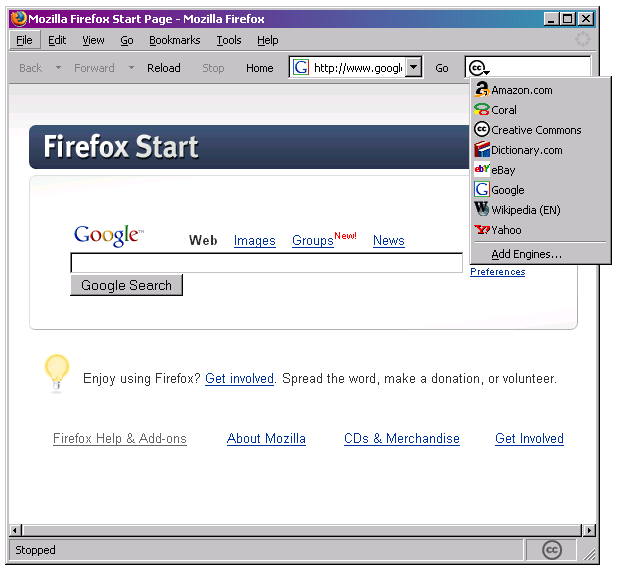
You can seach the web for content with creative commons licenses by using the CC search engine:
http://search.creativecommons.org/#

or, you can do this directly by selecting the CC logo in the drop down mini menu bar of your Firefox browser:


If you dont have Firefox, you should; it is one of the best web browsers available. You can download the search engine at Mozilla's website: http://www.mozilla.com/en-US/

Some interesting stats about internet usage...

Carroll, Michael W., "Creative Commons and the New Intermediaries" . Michigan State Law Review, Symposium, 2005 Available at SSRN: http://ssrn.com/abstract=782405

Young people, especially teenagers have taken advantage of the internet to express themselves and be creative in a number of different ways. "According to a study conducted by the Pew Internet & American Life Project in 2006, about 21 million or 87 percent of those ages 12-17 in the United States use the Internet. Teens are eager to share their thoughts, experiences, and creations with the wider Internet population. Here are some of the study's key findings:
  • 33 % of online teens share their own creative content online, such as artwork, photos, stories, or videos.
  • 32% say that they have created or worked on Web pages or blogs for others, including groups they belong to , friends, or school assignments.
  • 22% report keeping their own personal Web page
  • 19% of online teens keep a blog, and 38% of online teens read blogs.
  • 19% of Internet-using teens say they remix content they find online into their own artistic creations
Each of these works is subject to copyright. Indeed, nearly every Web page, graphic image, photograph, song, or video one encounters on the Internet is a work of authorship to which a number of exclusive rights are attached" (Carroll, pg. 447).

Much of today's discussion about copyright is not only obsolete, but impractical and unrealistic.

What percentage of the population (or percentage of those who use the internet) must declare that they intentionally or unintentionally infringe upon the rights of another in order for the society at large to realize that many of these infringements should constitute crimes? Moreover, when will it become clear that many of these activities should be encouraged and lauded as valuable learning tools, freedom of speech, creation of culture, and yes, acts that promote economic growth?

Wednesday, December 5, 2007

Copyright Reform proposals

Samuelson, Pamela, "Preliminary Thoughts on Copyright Reform" . Utah Law Review, 2007 Available at SSRN: http://ssrn.com/abstract=1002676

Pamela Samuelson, co-director of the Berkeley Center for Law and Technology, has authored an interesting paper on possible directions for copyright reform. With reform she proposes to fix current problems, such as that of orphan works which is very important for film makers and other creators. She also discusses the possibility of drafting a model copyright act which would have to face the issues of either being “US-centric” or more internationally neutral. She also has a podcast on "Open Source Development and Distribution of Digital Information."

Monday, December 3, 2007

Professor Michael Carroll knows how to explain Creative Commons

Carroll, Michael W., "Creative Commons and the New Intermediaries" . Michigan State Law Review, Symposium, 2005 Available at SSRN: http://ssrn.com/abstract=782405

Carroll does an incredible job explaining what Creative Commons is for someone who does not have a legal background or who is not very tech savy. He provides a brief overview of the history of U.S. copyright law that leads to the conclusion that the system in this country is based on a "one size fits all" approach (A.K.A. copyright = "all rights reserved") to control of creative works. Today's society depends upon and thrives off of the internet and digital technologies. In today's world, "one size fits all" is an obsolete phenomenon with regard the control of creative work. A.K.A. the "all rights reserved" mantra of copyright is inefficient and ineffective. Creative Commons is the answer..."some rights reserved."